
The Cost of a Cake — Part 1
When my husband and I first got married, we spent a year living in Frankfurt. I had just moved from another country, barely spoke German, and for the first time in my life, I had something I wasn’t particularly used to having.
Time.
I spent much of that year exploring the city, wandering into little shops and cafés, discovering things I hadn’t known existed, and somewhere along the way, Frankfurt became a place I grew to love so much that even now, when we no longer live there, I still think of it as home.
One of my favourite discoveries was German cake. Growing up in Asia, cakes had never been something I was particularly excited about, but Germany changed that, and of all the cakes I tried, there was one I loved more than any other. Frankfurter Kranz, a traditional German cake made with layers of sponge, German buttercream, jam and crunchy caramelised nuts.
I haven’t been able to find one where I live now, and perhaps that’s partly why I’ve been entertaining the idea of opening a German bakery myself. Not that I’ve made any decisions yet, but lately I’ve been thinking about what such a business might look like, what I would need to get started, and whether it could actually be profitable.
Having run a skincare business before, I know that calculating the cost of a product isn’t simply a matter of adding up the materials that go into it. I also know how easy it is to become attached to an idea before properly examining the numbers behind it. I already know I love the cake, and I’d love to introduce it to people who have never tried it, but none of that tells me whether producing and selling it would make financial sense.
Naturally, one of the first questions I found myself asking was how much it would cost to make a cake. It sounds like a fairly straightforward question until we begin thinking about what we actually mean by cost.
Starting With the Ingredients
If I were to make a Frankfurter Kranz that could be divided into twelve slices, before thinking about renting a shop or buying an industrial oven, I should probably start by writing down everything I would need to make one cake.
Butter, flour, eggs, sugar, jam, nuts and a few other ingredients. I could visit a supermarket, compare prices, work out how much of each ingredient the recipe requires and calculate the total. Let’s imagine the ingredients come to €18. Add another €2 for a cake box and packaging, and I have a total of €20.
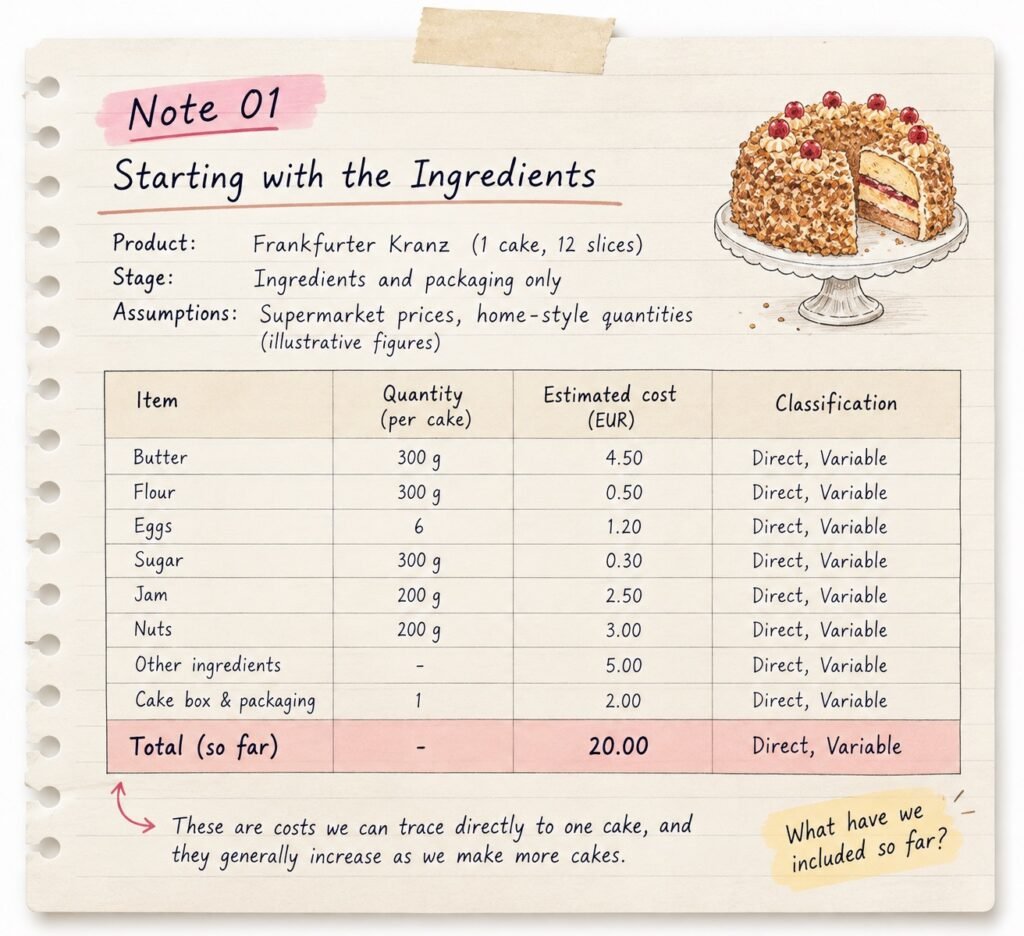
Does that mean my cake costs €20 to make?
If I’m baking it at home for a friend’s birthday, perhaps that’s a perfectly reasonable way of thinking about what I’ve spent, particularly if I already have the equipment and don’t intend to charge for my time. But when planning to sell cakes regularly, €20 tells me only a very small part of the story.
To actually open a bakery and sell cakes, I would have to prepare the ingredients, bake the sponge, make the buttercream, assemble the layers, decorate the cake and clean up afterwards. While there is no fixed price tag like at the supermarket, all of this takes time, and if I eventually hire someone to do the work, that time will become a cost my business has to pay.
Then there would also be the electricity used by the oven and refrigerator, the equipment needed to produce the cake, and the kitchen in which everything happens. The ingredients are relatively easy to trace to one cake, but the other costs are not always so straightforward, and this is where the distinction between direct and indirect costs becomes useful.
Which Costs Belong to the Cake?
In accounting, we call something a direct cost when we can identify and measure it specifically in relation to the product we’re producing.
If I use 300 grams of butter to make one cake, I can calculate the cost of those 300 grams and assign it directly to that cake. The same applies to the flour, eggs, sugar and other ingredients. The labour cost can also be traced directly to the product, assuming I’m costing it based on the hours spent preparing a particular cake.
But what about the cost of using the oven?
The oven isn’t used for just one cake. I might use it to bake several cakes in a day, perhaps even different types of products, and its purchase cost would be spread over years of use. The electricity bill might cover the oven, refrigerator, lighting and other equipment in the kitchen. These are examples of costs that may be indirect to an individual cake, and while they support production, we cannot necessarily assign them to one product without choosing some method of allocation.
We call these indirect costs, or overheads.
The ingredients give us a reasonably traceable number, but the shared indirect costs can only be assigned once we introduce assumptions about how much of those costs each cake should bear. Those assumptions matter because they can influence the profitability we believe each product generates, and the result may change depending on the costing method we choose to apply.
For now, though, there’s another distinction worth understanding, because not all costs behave the same way when we produce more cakes.
What Happens When We Make Ten Cakes Instead of One?
So, my bakery has started operating, and instead of making one Frankfurter Kranz, we receive orders for ten cakes within the first week. Assuming the recipe and ingredient prices remain unchanged, we would need roughly ten times the ingredients, which means that if one cake requires €18 worth of ingredients, ten cakes would require €180.
This is an example of a variable cost, a cost that changes in total as production volume changes.
But what about the monthly rent for our kitchen?
At the moment, I’m paying €1,200 a month. It’s a cost that I will have to pay every month whether we make ten cakes or one hundred cakes. The rent remains €1,200, at least within the capacity and terms of our existing kitchen. For the purpose of analysing cost behaviour, we would classify the rent as a fixed cost.
The distinction becomes particularly useful when we calculate costs per cake. Imagine we produce 100 cakes in a month. The €1,200 rent works out to €12 per cake, but if we produce 200 cakes, the same rent works out to €6 per cake.
| Monthly production | Total rent | Rent per cake |
|---|---|---|
| 100 cakes | €1,200 | €12 |
| 200 cakes | €1,200 | €6 |
| 300 cakes | €1,200 | €4 |
Nothing about the rent itself has become cheaper. We haven’t negotiated a better lease or found a less expensive kitchen, but by producing more cakes using the same space, we’ve spread the €1,200 across a greater number of products. This is why fixed costs behave differently depending on whether we look at them in total or per unit.
Looking at the cost per cake, it almost feels as though we’re becoming more efficient simply by producing more. And perhaps we are making better use of the kitchen we’ve already paid for, but there’s an important distinction between reducing the amount of rent allocated to each cake and actually reducing what the business spends. We’re not saving €600 in rent by producing twice as many cakes. We’re still paying €1,200, and whether producing those additional cakes makes financial sense would depend on the additional costs and revenue involved.
Of course, this doesn’t mean we can continue increasing production indefinitely. At some point, we might need a larger kitchen, another oven or additional employees, and our costs would change again. A cost can remain fixed over a certain range of activity without remaining fixed forever.
A Cost Can Be More Than One Thing
I think there is something else worth clarifying before we go further because this confused me a lot while studying costing.
Direct and indirect costs describe whether we can trace a cost to a particular product.
Fixed and variable costs describe how that cost behaves when activity changes.
The butter used in our Frankfurter Kranz is both a direct cost and a variable cost because we can trace it to the cake, and at the same time, the total amount we spend on butter generally increases as we make more cakes. The kitchen rent, on the other hand, is normally an indirect cost of an individual cake and a fixed cost within the relevant production range.
Not every cost fits only these two combinations, however.
If we are paying a baker a fixed monthly salary, and that baker works exclusively on Frankfurter Kranz, their salary may be directly attributable to that product, but the total salary doesn’t necessarily change just because we make a few more cakes. Likewise, electricity used in a shared oven may vary with production activity, while remaining difficult to trace precisely to individual cakes.
So we could have a direct fixed cost, or an indirect variable cost.
This is why we shouldn’t treat direct and variable as interchangeable terms, or assume that indirect costs must always be fixed. Understanding both classifications gives us two different pieces of information: where the cost belongs, and what happens to it when our activity changes.
So, How Much Does Our Cake Actually Cost?
To make one Frankfurter Kranz, we started with €18 in ingredients and €2 in packaging. Assuming we now estimate another €15 in directly attributable labour for preparing and decorating the cake, that brings our identifiable cost to €35.
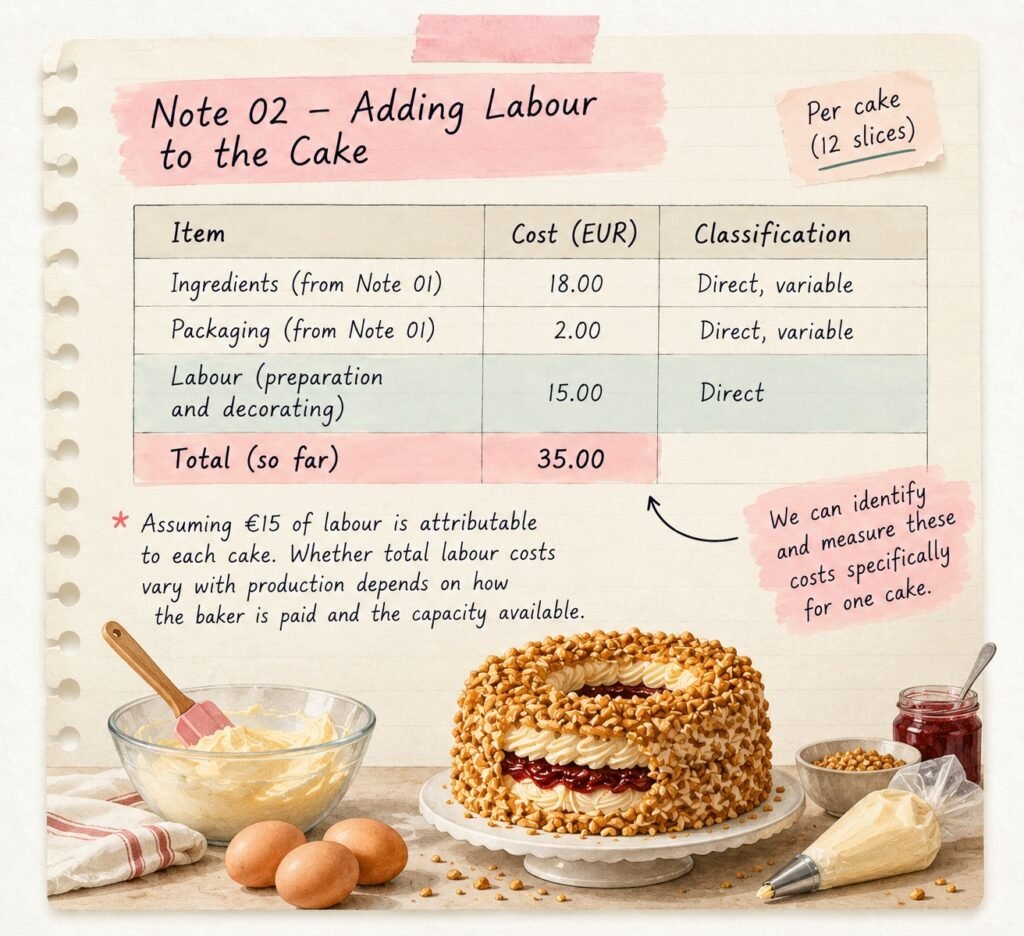
But we still haven’t accounted for the kitchen, equipment, shared electricity and other overheads. If we allocate €12 of monthly kitchen rent to each cake based on producing 100 cakes, the amount rises to €47, even before considering those other shared costs.
Does that mean €47 is the correct cost?
Not necessarily, because the €35 represents the direct costs we’ve identified under our assumptions. The additional €12 is an allocation of a cost that the business incurs regardless of whether we produce this particular cake. However, if we produce 200 cakes instead, the allocated rent falls to €6 per cake, reducing the calculated amount to €41.
We haven’t changed anything about the cake. We’re still using the same recipe and the same ingredients, and assuming the labour required is the same. The only thing that has changed is the number of cakes we bake using the capacity over which we spread the rent.
This is the part that makes me question what we actually mean when we say a product costs a certain amount to make, because if someone asked me how much it costs to produce a Frankfurter Kranz, I would naturally want to give them a number. We tend to expect numbers to be precise, particularly when they come from a financial calculation, and €47 certainly sounds more definite than saying it depends.
But if I calculated €47 in one month and €41 in another, would that really mean I’d found a way to make the same cake €6 cheaper?
Not in terms of the direct resources used to produce it. What has changed is the amount of shared cost attributed to each cake, and that tells us something about how the bakery is using its capacity rather than necessarily telling us that the cake itself has become cheaper to produce.
Both figures describe the business under different production assumptions, and neither yet includes every relevant cost.
We often talk about product cost as though it were a single, objective number waiting to be discovered. In reality, part of that number depends on what we decide to include, how we assign shared expenses, and what we’re trying to understand.
If I want to know how much cash I need to purchase ingredients for tomorrow’s orders, allocating a portion of monthly rent to every cake may not be particularly useful. But if I want to understand whether the bakery can cover all its operating costs over the year, ignoring rent would be equally unhelpful. I might even need to look at costs differently again if I’m trying to decide whether to accept one additional order when the kitchen has spare capacity.
Understanding the Cost Before Making the Decision
If I were seriously considering opening this bakery, I wouldn’t want to make the decision based on a single cost figure, particularly one that could change simply because I’d assumed a different production volume. I’d want to understand how the business would perform when orders were slow, what would happen if demand increased, and whether the prices customers were willing to pay would be enough to support the kitchen, the people working in it and everything else involved in keeping the bakery running.
I could calculate the cost of a Frankfurter Kranz down to the last gram of butter, but that still wouldn’t tell me whether opening a bakery to sell it would be a good decision.
If I eventually produce several different cakes in the same kitchen, I’ll also have to decide how to distribute the shared expenses between them. Depending on how I do that, one cake might appear considerably more profitable than another, even when nothing about the way either cake is made has changed.
If two cakes use the same oven, the same kitchen and the same employees, but require very different amounts of time and effort to prepare, how do we decide how much of those shared costs belongs to each one?
Next in The Cost of a Cake: Who Pays for the Oven? — Understanding absorption costing and activity-based costing.
